Rental returns
What return should a Myrtle Beach rental make?
By area, with and without a manager.
By Devin Day, Operations Officer · Reviewed by Tim Nash, Broker-in-Charge · Updated September 11, 2026
Most Myrtle Beach rentals keep about 4 to 9 percent of the price in rent each year, after every cost. Whatever the house appreciates is on top of that.
The short answer
A Horry County rental costs about $160,703 to $263,914, depending on the area. The average return is 5.5 percent a year after costs, with a property manager, and 6.5 percent without one. Appreciation is on average 4.8 percent a year over the last five years and 6.1 percent over the last ten.
What return should you expect on a Myrtle Beach rental?
A rental pays you two ways. The rent left after the cost of owning the house, and the appreciation when you sell.
The three return tiles assume you paid cash. A loan changes the money you put in, and adds a payment the rent has to cover. That is the coverage ratio, and it is one of the four dealbreakers below.
| Number | What it means | Here |
|---|---|---|
| Cap rate | The rent left after the cost of owning the house, divided by the price. No loan in it. | 4.2 to 7.5 percent with a manager |
| Appreciation | How much the value of the house rises each year. | +4.8 percent a year over five years |
| Coverage ratio | The rent divided by the monthly cost of the loan, taxes, insurance and dues. | Our target is 1.25 |
| Occupancy | The share of nights a short-term rental is booked. | 30 to 38 percent across the year |
A national research firm puts the cap rate on single-family rentals at 7.3 percent for late 2025. Myrtle Beach sits inside that range once you use the price a rental sells for.
How expensive are rental properties in Myrtle Beach?
Zillow publishes a typical value for every home in a ZIP code. In Murrells Inlet that is $401,110. It counts oceanfront houses, second homes and everything else. Almost nobody buys that house as a rental.
Zillow also publishes the value of the cheaper third of homes in the same ZIP. In Murrells Inlet that is $263,914. That is much closer to what a rental sells for here, and it is the price this page uses.
The rent barely changes between the two. The county's three-bedroom benchmark rent is $1,823 either way. The price you divide by decides the whole return.
| Area | A rental costs about | Every home in the area | Return on the rental | Return on the typical home |
|---|---|---|---|---|
| Myrtle Beach | $160,703 | $279,713 | 7.5% | 3.6% |
| Surfside Beach | $184,410 | $360,243 | 6.6% | 2.7% |
| Little River | $209,142 | $323,004 | 5.7% | 3.3% |
| Conway | $214,498 | $302,222 | 5.1% | 3.2% |
| Carolina Forest | $234,304 | $359,496 | 5.0% | 2.8% |
| North Myrtle Beach | $247,339 | $400,143 | 4.5% | 2.3% |
| Murrells Inlet and Garden City | $263,914 | $401,110 | 4.2% | 2.4% |
| Pawleys Island | $320,314 | $550,277 | 1.8% | 0.4% |
In the Myrtle Beach city core that is the difference between 3.6 percent and 7.5 percent, on the same rent. Divide by the wrong price and a normal market looks like a bad one.
One caution on the costs. This page keeps insurance at $3,050 on every house, which is the middle of our landlord range. A smaller house usually insures for less, so the real return on a cheaper house is a little higher than the table shows.
Have us find you your next investment.
Tell us the area and what you want the house to do. We send you what fits, including off-market properties that never reach the public sites, with the return run on each one.
Have us find your next investmentHow much does a long-term rental make in each area?
Each area has two bars. The dark bar is the return with a property manager taking 10 percent of the rent. The light bar is the same house with you managing it. Both allow 10 percent of the rent for empty months and repairs.
The rent is the same county benchmark everywhere, so price alone decides the order. The Myrtle Beach city core leads because a rental there costs $160,703. North Myrtle Beach and Murrells Inlet and Garden City trail because the same rent has to cover a $247,339 or $263,914 house.
| Area | Price | Rent a month | With a manager | Without one |
|---|---|---|---|---|
| Myrtle Beach | $160,703 | $1,823 | 7.5% | 8.8% |
| Surfside Beach | $184,410 | $1,823 | 6.6% | 7.7% |
| Little River | $209,142 | $1,823 | 5.7% | 6.7% |
| Conway | $214,498 | $1,823 | 5.1% | 6.1% |
| Carolina Forest | $234,304 | $1,823 | 5.0% | 5.9% |
| North Myrtle Beach | $247,339 | $1,823 | 4.5% | 5.4% |
| Murrells Inlet and Garden City | $263,914 | $1,823 | 4.2% | 5.1% |
| Pawleys Island | $320,314 | $1,380 | 1.8% | 2.3% |
One house, line by line
| Line | A year |
|---|---|
| Rent, 12 months at $1,823 | $21,876 |
| Empty months and repairs, 10 percent | −$2,188 |
| Management, 10 percent | −$2,188 |
| Property tax at 6 percent, 254.6 mills | −$2,455 |
| Landlord insurance | −$3,050 |
| Rent left | $11,996 |
| Divided by the $160,703 price | 7.5 percent |
Property tax is the biggest cost after the allowance. A rental pays the 6 percent ratio, not the 4 percent a home you live in pays. The property tax page has every district's rate, and the insurance page has the range.
The 10 percent allowance for empty months and repairs is close to what the market runs. South Carolina's rental vacancy rate was 9.8 percent in 2025. A lender is stricter and counts only 75 percent of the rent when it decides your loan.
How much does a nightly rental make in each area?
Every bar here is the same house. The brass bar is that house on a yearly lease. The two green bars are the same house rented nightly: first at the occupancy its market averages, then at 60 percent, which is what a well-run listing books.
The revenue and occupancy are the average of every active listing in each market, August 2025 to July 2026. Nightly costs take 55 percent of revenue, covering management, cleaning, utilities, platform fees, the 6 percent tax and insurance.
Occupancy decides it. The average listing books only 30 to 38 percent of its nights, and at that rate 6 of the 8 markets beat a yearly lease. Get the same house to 60 percent and every market beats it, most of them twice over. Surfside Beach goes from 4.4 percent to 7.8 percent.
| Market | Listings | Nights booked | Revenue a listing | Cap rate now | Cap rate at 60% | Occupancy to beat a yearly lease |
|---|---|---|---|---|---|---|
| Surfside Beach | 538 | 34% | $35,482 a year | 4.4% | 7.8% | 21.0% |
| Murrells Inlet | 461 | 38% | $38,356 a year | 4.3% | 6.8% | 20.7% |
| Garden City | 395 | 36% | $33,942 a year | 3.8% | 6.3% | 22.4% |
| Myrtle Beach | 8,583 | 33% | $20,946 a year | 3.4% | 6.1% | 35.8% |
| North Myrtle Beach | 4,406 | 32% | $28,667 a year | 3.2% | 6.0% | 23.1% |
| Conway | 106 | 35% | $21,285 a year | 3.2% | 5.5% | 34.7% |
| Pawleys Island | 428 | 33% | $27,953 a year | 2.3% | 4.1% | 6.3% |
| Little River | 171 | 30% | $12,243 a year | 1.7% | 3.4% | 58.1% |
The cap rate is the rent left after costs divided by the price, with no loan in it. The last column is the occupancy a nightly rental needs to match a yearly lease on that house. In Murrells Inlet and Garden City and Surfside Beach that bar is around 21 percent, which the market already clears. In Little River it is 58.1 percent, which almost nothing clears.
This section divides by the typical home value, not the cheaper third above. The listings earning this revenue are mostly beach properties, not the cheapest houses in the area.
Carolina Forest has no nightly figure because our data source does not measure it. That is not the same as no demand. It sits beside the new Carolina Forest hospital, and a furnished monthly rental there serves traveling nurses on 13-week contracts. Furnished monthly rentals covers that, and where to buy has the nightly-rental rules, which ban them in most neighborhoods.
Which area is best for each number?
Hover an area, or tap it, for its numbers. The buttons change what the color shows. Darker is higher.
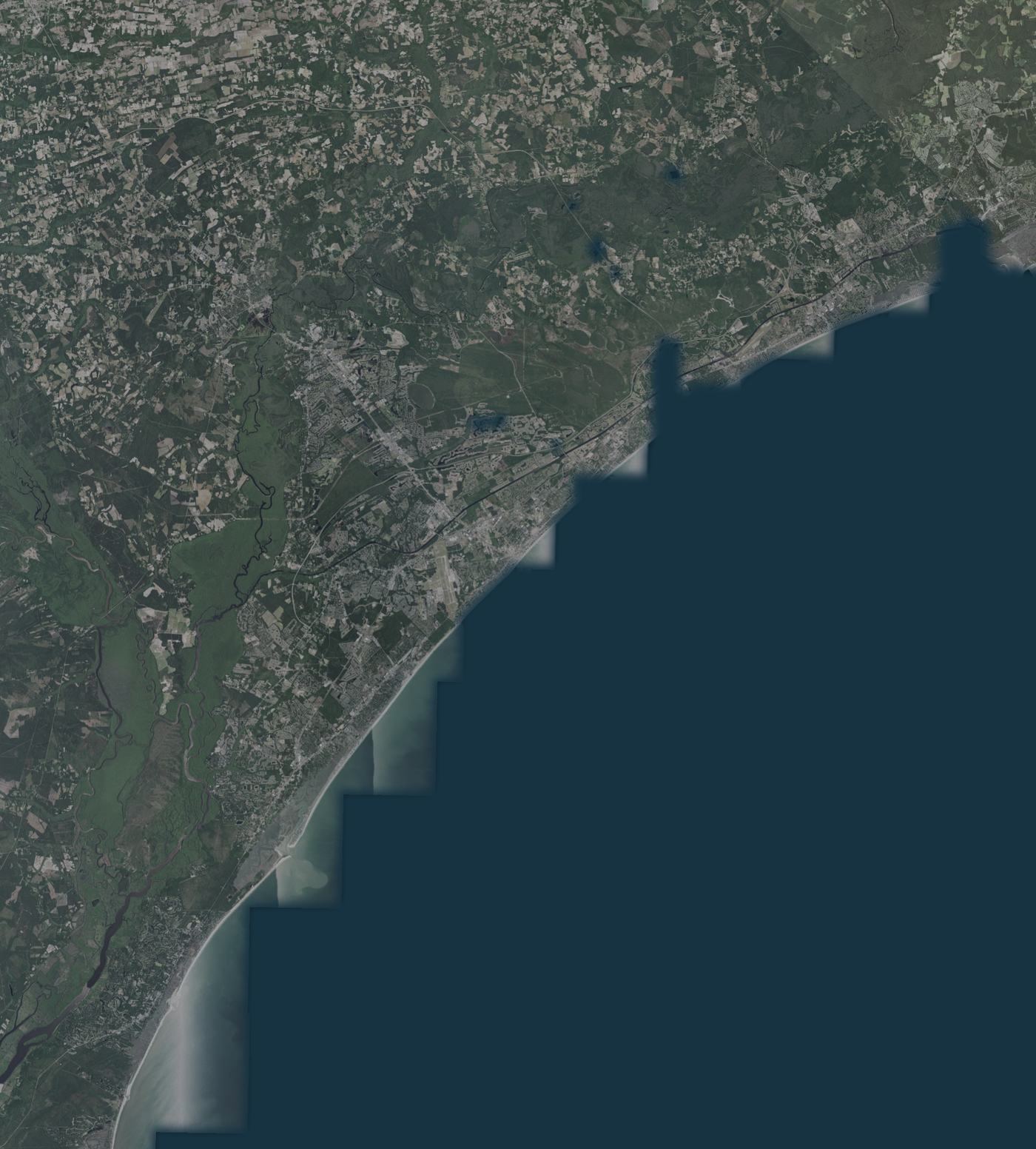
Imagery: U.S. Geological Survey, The National Map. Boundaries: U.S. Census Bureau ZIP code tabulation areas. Both public domain. Prices and rents: Zillow and HUD, July 2026. Short-term figures: AirROI, August 2025 to July 2026.
| If you want | Look at | Why |
|---|---|---|
| The highest rent return | Myrtle Beach, Surfside Beach | The rent is the same across Horry County. These have the cheapest houses. |
| The highest nightly return | Surfside Beach, Murrells Inlet | The most booking revenue for the price of a house there. |
| The most nights booked | Murrells Inlet (38%), Garden City (36%) | Steadier bookings across the shoulder months. |
| The strongest appreciation | Pawleys Island (+6.7%), Surfside Beach (+5.6%) | Five-year rate. Ten-year order differs. |
| The lowest price to start | Myrtle Beach ($160,703), Surfside Beach ($184,410) | Less cash in, and the rent barely changes. |
| A tenant all year, not a guest | Carolina Forest, Conway | Year-round households and workers, away from the nightly-rental rules. |
Nightly rentals are banned in most Grand Strand neighborhoods, so the area decides the strategy before the numbers do. Where to buy a rental has the rule, the license and the taxes for each area.
When should you walk away?
Four numbers. If a house misses one of them, we say so before you write an offer.
| The number | When we walk | Why we walk |
|---|---|---|
| Coverage ratio | Below 1.25, walk | You take in 25 percent more rent each month than the loan, the taxes, the insurance and the dues cost you. Enough houses here do that. Accepting less makes no sense. |
| Cap rate | Below 6 percent, walk | This is how much you make each year against how much of your money went into the house. We target the top end of the market at 6 percent. |
| Appreciation | Below 3 percent a year, walk | Below 3 percent a year usually means the location is not in demand. Unless it rents very well, we do not bring those to customers. |
| Occupancy | Below 60 percent a year, walk | This depends mostly on the property manager. In a good location 60 percent is very doable. |
The market average looks low for short-term rentals because it counts every part-time and badly run listing.
These are Chapter3's numbers, not an industry standard. No published study says what one rental house should return. They are not a promise about what one house will do. The DSCR page has the loan side of the coverage ratio.
Every investor's goals are different.
Tell us what you want the house to do, and we find properties that fit those goals and run all four numbers on each one.
Have us find properties for your goalsCalculate how much your Myrtle Beach rental will make
Pick the area, then enter a price and a rent. Add the insurance, the dues and your monthly loan payment when you have them. The tool takes out the allowance, the property tax for that area, insurance and dues, and shows the return with a manager and without one.
Investment calculator
Want the full report on one address?
The rental analyzer takes an address and returns the value, the market rent, the coverage ratio, the cash flow and the permits filed nearby.
Open the rental analyzerHow much does appreciation add?
The chart takes a $150,000 rental in the Myrtle Beach city core and shows what it is worth later. The grey block is what you paid. The blue block is what the house gained.
The blue blocks grow at 6.1 percent a year, which is what the metro averaged over the last ten years. That is a record, not a promise. Over the last three years the same measure fell 1.7 percent. The rent is what paid the owner over those three years.
Buy on the rent, and treat appreciation as a bonus.
How long to hold a rental before selling has the price history for every area and the years it takes to earn the selling costs back.
Common questions
Rental returns FAQ
What is a good cap rate for a rental in Myrtle Beach?
Six percent or better is our target. A Horry County rental bought in the cheaper third of the market returns 4.2 to 7.5 percent with a property manager and 5.1 to 8.8 percent without one. A national research firm put single-family cap rates at 7.3 percent in late 2025, so the better Myrtle Beach areas sit right in that range.
Why do Myrtle Beach cap rates look so low in some reports?
Because they divide the rent by the typical value of every home in the area, which includes oceanfront houses and second homes nobody rents out. Use the price a rental sells for and the same rent returns far more. In the Myrtle Beach city core that is the difference between 3.6 percent and 7.5 percent.
What DSCR do you need for a Myrtle Beach rental?
Our target is 1.25. Divide the monthly rent by the monthly cost of the loan, taxes, insurance and dues. At $1,823 of rent, 1.25 means all of those together stay under $1,458 a month. Some lenders will fund below that and charge for it.
Which Myrtle Beach area has the best rental returns?
For long-term rent, Myrtle Beach and Surfside Beach, because the houses cost least and the rent is the same across the county. For nightly rentals, Surfside Beach and Murrells Inlet, once the house is run well enough to book 60 percent of its nights.
Does a property manager make a rental worth it?
A manager takes about 10 percent of the rent, which costs roughly one point of return. On a short-term rental the manager usually earns it back. The middle listing books 25 to 36 percent of nights. The top tenth books 67 to 76 percent. On a long-term rental, self-managing is worth about one extra point a year.
How much does a Myrtle Beach rental appreciate?
The metro rose 4.8 percent a year over five years and 6.1 percent a year over ten. Over the last three years it fell 1.7 percent in total. Our target is 3 percent a year over the long run.
Sources: Zillow home values and rents, AirROI, HUD fair market rents, Arbor single-family report, LendingOne on DSCR, Newfi on DSCR, FRED, SC vacancy, Horry County Assessor, Georgetown County tax. Read September 11, 2026. Educational only, not a loan offer and not an appraisal. Chapter3 is a real estate brokerage. Area figures are not a quote on one house.
Tell us what you want a rental to do.
One call. Your goal, the areas that fit it, and all four numbers run on every house before you offer.
Call a specialized agent